
Uploaded By CloudSoft , Support Us as we Support Comrades through Making Comrades Access to Various services Easy.
Whatsapp 0717422950 (Recommend and Always Support Us by Getting Served at CloudSoft Cyber Student Centre Entrance – Where Written CloudSoft HUDUMA on the Banner)

COURSES TO REGISTER SEMESTER ONE
SCHOOL OF ARTS AND SOCIAL SCIENCES
DEPARTMENT OF LITERATURE, LINGUISTICS, FOREIGN LANGUAGES AND FILM STUDIES
REGISTRATION/COURSES ON OFFER: 2025/2026 ACADEMIC YEAR
YEAR 1 SEMESTER 1 (AUGUST-DECMBER 2026)
You are hereby guided to register (online portal) for the following courses on offer, before elapse of the set deadline (20% of the semester):
NB: You are ALL required to take a minimum of SEVEN courses
- SAS 101: Introduction to Reading and Writing Skills.
- SAS 102: Computer Literacy and Skills
- BLL110: Introduction to Academic writing
- LIN 110: Introduction to the Study of Language
- LMC 110: Introduction to Media and society
- LMC 111: Understanding Communication
- KIS 111: Introduction to Translation and Interpretation
ELECTIVES: (OPTIONAL) ENCOURAGED TO CHOOSE ANY ONE; (OR ELSE BOTH)
- BLL 111: Introduction to French
- BLL112: Beginners German
YEAR 2 SEMESTER 1
- SAS 201: Introduction to Research Methods
- LIN 210: Introduction to Sociolinguistics
- ENG 210: English Phonetics
- KIS 210: Theory and Practice of Translation1
- LMC 210: Communication Theory
- LMC 211: Introduction to Media Theories
ELECTIVES:MUST CHOOSE ANY ONE;(OR ELSE BOTH)
- BLL 211: Intermediate French
- BLL 213: Intermediate German
YEAR 3 SEMESTER 1
- SAS 301: Contemporary Gender Issues
- BLL 310: Business English
- LMC 310: Intercultural communication
- LMC 311: Introduction to Media Law
- LMC 312: Corporate Communication Strategies
- LIN 313: Theories of Editing
ELECTIVES:MUST CHOOSE ANY ONE;(OR ELSE BOTH)
- BLL 311: French language Skills for the media
- BLL 312: Further Intermediate German
YEAR 4 SEMESTER 1
- SAS 401: Policy Analysis and Project Management
- ENG 411: Practical English Stylistics
- LMC 410: Research Project in LMC
- LMC 411: Comparative Media Law and Governance
- LMC 412: Feminist Films
- LTF 411: Literary journalism
ELECTIVES:MUST CHOOSE ANY ONE;(OR ELSE BOTH)
- BLL 410: Intermediate French for Journalism
- BLL 411: Advanced Grammar and Reading Comprehension
Wishing you a successful semester
COD,
DEPARTMENT OF LITERATURE, LINGUISTICS, FOREIGN LANGUAGES AND FILM STUDIES
(ISO- 9001:2015 Certified Institution)
SCHOOL OF EDUCATION GUIDE
Moi University Students Guide,First Years Education By CloudSoft
Table of Contents
- History of Moi University
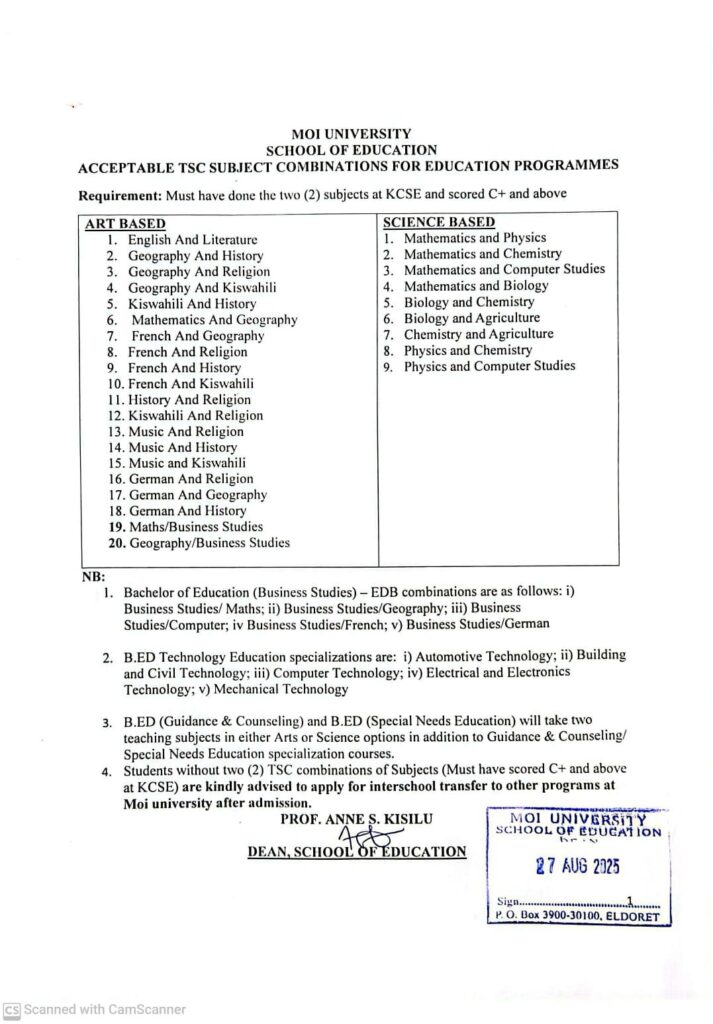
- Acceptable TSC Subject Combinations for Education Programmes
- All Courses/Units (Revised 2024)
- Bachelor of Education (Science) Programme
- Bachelor of Education (Business Studies) Programme
- Bachelor of Education (Early Childhood Development & Education) Programme
- Bachelor of Education (Special Needs Education) Programme
- Bachelor of Science with Education Programme
- Bachelor of Education (Arts)
- Bachelor of Arts with Education Programme
- Bachelor of Education (Guidance & Counseling) Programme
- Department Guides
- School of Education
- School of Science
- Lecture Halls
- School of Education and Arts
- Lecture Halls School of Agriculture
- Lecture Halls School of Science
- Portal Navigation
History of Moi University
Moi University was established in 1984 through the Moi University Act, 1984, as Kenya’s second public university. Its founding was based on a recommendation from a Presidential Working Party led by Prof. Collins B. Mackay. The idea for a university in a rural setting was pioneered by President Daniel Toroitich arap Moi, who believed in decentralizing higher education from Nairobi. The university was named in his honor as a “modest tribute” to his efforts.
The first Vice-Chancellor, Prof. Odhiambo, began the university with 83 students from the University of Nairobi’s Forestry Department. He took them to Eldoret, where they started with three tents at Kaptagat Hotel, two for lectures and one for his office. The university later relocated to a 3,000-acre site in Kesses.
Moi University was founded with a focus on science, technology, and development, aiming to address rural development issues through its training and research. The main campus is located in Kesses, 35 kilometers from Eldoret and 310 kilometers northwest of Nairobi.
Since 1984, the university has experienced significant growth, leading to the establishment of several constituent colleges that have since become fully-fledged universities, including Maseno, Masinde Muliro, Maasai Mara, and the University of Eldoret. In 2017, the university re-established the School of Graduate Studies and reorganized some of its programs. The former School of Human Resource Development was converted into the Institute of Entrepreneurship and Development Studies.
Moi University’s student population has grown from 83 in 1984 to about 40,000, with a staff component of 3,000. It currently has two constituent colleges, Bomet University College and Alupe University College, and two campus colleges, the College of Health Sciences in Eldoret and Odera Akang’o Campus in Yala. The university also has other campuses strategically located across the country, such as in Kitale, Nairobi, and Eldoret West.
Acceptable TSC Subject Combinations for Education Programmes
To be eligible, students must have scored a C+ and above in the two subjects at KCSE.
| Art Based | Science Based |
| 1. English and Literature | 1. Mathematics and Physics |
| 2. Geography and History | 2. Mathematics and Chemistry |
| 3. Geography and Religion | 3. Mathematics and Computer Studies |
| 4. Geography and Kiswahili | 4. Mathematics and Biology |
| 5. Kiswahili and History | 5. Biology and Chemistry |
| 6. Mathematics and Geography | 6. Biology and Agriculture |
| 7. French and Geography | 7. Chemistry and Agriculture |
| 8. French and Religion | 8. Physics and Chemistry |
| 9. French and History | 9. Physics and Computer Studies |
| 10. French and Kiswahili | |
| 11. History and Religion | |
| 12. Kiswahili and Religion | |
| 13. Music and Religion | |
| 14. Music and History | |
| 15. German and Religion | |
| 16. German and Geography | |
| 17. German and History | |
| 18. Maths/Business Studies (for EDB program only) | |
| 19. Geography/Business Studies (for EDB program only) |
Notes:
- Bachelor of Education (Business Studies) – EDB combinations are: Business Studies/Math, Business Studies/Geography, Business Studies/Computer, Business Studies/French, and Business Studies/German.
- B.ED Technology Education specializations are: Automotive Technology, Building and Civil Technology, Computer Technology, Electrical and Electronics Technology, and Mechanical Technology.
- B.ED (Guidance & Counseling) and B.ED (Special Needs Education) students will take two teaching subjects from either the Arts or Science options in addition to their specialization courses.
- Students without the required two TSC subject combinations (C+ and above at KCSE) are advised to apply for an interschool transfer to other programs at Moi University after admission.
All Courses/Units (Revised 2024)
Bachelor of Education (Science) Programme
| Course Code | Course Title | Units | Core/Elective | Year | Semester |
| First Year | Semester 1 | ||||
| CIM 110 | Communication and Collaboration Skills in Education | 3 | Core | 1 | 1 |
| EMP 100 | Teacher Education and the Teaching Profession | 3 | Core | 1 | 1 |
| PSY 110 | Quantitative and Qualitative Techniques in Education | 3 | Core | 1 | 1 |
| SNE 100 | Special Needs and Inclusive Education | 3 | Core | 1 | 1 |
| First Year | Semester 2 | ||||
| EDF 111 | Philosophy of Education | 3 | Core | 1 | 2 |
| EDF 112 | Character Education and Integrity | 3 | Core | 1 | 2 |
| PSY 112 | General Educational Psychology | 3 | Core | 1 | 2 |
| TED 102 | Information and Communication Technology in Education | 3 | Core | 1 | 2 |
Bachelor of Education (Business Studies) Programme
| Course Code | Course Title | Units | Core/Elective | Year | Semester |
| First Year | Semester 1 | ||||
| CIM 110 | Communication and Collaboration Skills in Education | 3 | Core | 1 | 1 |
| EMP 100 | Teacher Education and the Teaching Profession | 3 | Core | 1 | 1 |
| PSY 110 | Quantitative and Qualitative Techniques in Education | 3 | Core | 1 | 1 |
| SNE 100 | Special Needs and Inclusive Education | 3 | Core | 1 | 1 |
| First Year | Semester 2 | ||||
| EDF 111 | Philosophy of Education | 3 | Core | 1 | 2 |
| EDF 112 | Character Education and Integrity | 3 | Core | 1 | 2 |
| PSY 112 | General Educational Psychology | 3 | Core | 1 | 2 |
| TED 102 | Information and Communication Technology in Education | 3 | Core | 1 | 2 |
Bachelor of Education (Early Childhood Development & Education) Programme
| Course Code | Course Title | Units | Core/Elective | Year | Semester |
| First Year | Semester 1 | ||||
| CIM 110 | Communication and Collaboration Skills in Education | 3 | Core | 1 | 1 |
| EMP 100 | Teacher Education and the Teaching Profession | 3 | Core | 1 | 1 |
| PSY 110 | Quantitative and Qualitative Techniques in Education | 3 | Core | 1 | 1 |
| SNE 100 | Special Needs and Inclusive Education | 3 | Core | 1 | 1 |
| ECD 111 | Introduction to Science | 3 | Core | 1 | 1 |
| ECD 112 | Introduction to Mathematics I | 3 | Core | 1 | 1 |
| ECD 113 | Introduction to English Language | 3 | Core | 1 | 1 |
| ECD 114 | Cultural Studies | 3 | Core | 1 | 1 |
| First Year | Semester 2 | ||||
| EDF 111 | Philosophy of Education | 3 | Core | 1 | 2 |
| EDF 112 | Character Education and Integrity | 3 | Core | 1 | 2 |
| PSY 112 | General Educational Psychology | 3 | Core | 1 | 2 |
| TED 102 | Information and Communication Technology in Education | 3 | Core | 1 | 2 |
| ECD 121 | Health and Hygiene Practices | 3 | Core | 1 | 2 |
| ECD 123 | Kiswahili and Theories of Vernacular | 3 | Core | 1 | 2 |
| ECD 125 | Introduction to Art & Craft | 3 | Core | 1 | 2 |
| ECD 126 | Food and Nutrition | 3 | Core | 1 | 2 |
Bachelor of Education (Special Needs Education) Programme
| Course Code | Course Title | Units | Core/Elective | Year | Semester |
| First Year | Semester 1 | ||||
| CIM 110 | Communication and Collaboration Skills in Education | 3 | Core | 1 | 1 |
| EMP 100 | Teacher Education and the Teaching Profession | 3 | Core | 1 | 1 |
| PSY 110 | Quantitative and Qualitative Techniques in Education | 3 | Core | 1 | 1 |
| SNE 100 | Special Needs and Inclusive Education | 3 | Core | 1 | 1 |
| First Year | Semester 2 | ||||
| EDF 111 | Philosophy of Education | 3 | Core | 1 | 2 |
| EDF 112 | Character Education and Integrity | 3 | Core | 1 | 2 |
| PSY 112 | General Educational Psychology | 3 | Core | 1 | 2 |
| TED 102 | Information and Communication Technology in Education | 3 | Core | 1 | 2 |
| SNE 110 | Behaviour Modification in Special Needs Education | 3 | Core | 1 | 2 |
Bachelor of Science with Education Programme
| Course Code | Course Title | Units | Core/Elective | Year | Semester |
| First Year | Semester 1 | ||||
| CIM 110 | Communication and Collaboration Skills in Education | 3 | Core | 1 | 1 |
| EMP 100 | Teacher Education and the Teaching Profession | 3 | Core | 1 | 1 |
| PSY 110 | Quantitative and Qualitative Techniques in Education | 3 | Core | 1 | 1 |
| SNE 100 | Special Needs and Inclusive Education | 3 | Core | 1 | 1 |
| First Year | Semester 2 | ||||
| EDF 111 | Philosophy of Education | 3 | Core | 1 | 2 |
| EDF 112 | Character Education and Integrity | 3 | Core | 1 | 2 |
| PSY 112 | General Educational Psychology | 3 | Core | 1 | 2 |
| TED 102 | Information and Communication Technology in Education | 3 | Core | 1 | 2 |
Bachelor of Education (Arts)
| Course Code | Course Title | Units | Core/Elective | Year | Semester |
| First Year | Semester 1 | ||||
| CIM 110 | Communication and Collaboration Skills in Education | 3 | Core | 1 | 1 |
| EMP 100 | Teacher Education and the Teaching Profession | 3 | Core | 1 | 1 |
| PSY 110 | Quantitative and Qualitative Techniques in Education | 3 | Core | 1 | 1 |
| SNE 100 | Special Needs and Inclusive Education | 3 | Core | 1 | 1 |
| First Year | Semester 2 | ||||
| EDF 111 | Philosophy of Education | 3 | Core | 1 | 2 |
| EDF 112 | Character Education and Integrity | 3 | Core | 1 | 2 |
| PSY 112 | General Educational Psychology | 3 | Core | 1 | 2 |
| TED 102 | Information and Communication Technology in Education | 3 | Core | 1 | 2 |
Bachelor of Arts with Education Programme
| Course Code | Course Title | Units | Core/Elective | Year | Semester |
| First Year | Semester 1 | ||||
| CIM 110 | Communication and Collaboration Skills in Education | 3 | Core | 1 | 1 |
| EMP 100 | Teacher Education and the Teaching Profession | 3 | Core | 1 | 1 |
| PSY 110 | Quantitative and Qualitative Techniques in Education | 3 | Core | 1 | 1 |
| SNE 100 | Special Needs and Inclusive Education | 3 | Core | 1 | 1 |
| SAS 111 | Communication Skills and Competencies | 3 | Core | 1 | 1 |
| First Year | Semester 2 | ||||
| EDF 111 | Philosophy of Education | 3 | Core | 1 | 2 |
| EDF 112 | Character Education and Integrity | 3 | Core | 1 | 2 |
| PSY 112 | General Educational Psychology | 3 | Core | 1 | 2 |
| TED 102 | Information and Communication Technology in Education | 3 | Core | 1 | 2 |
| SAS 121 | Digital Literacy | 3 | Core | 1 | 2 |
| SAS 122 | Social Science Perspectives | 3 | Core | 1 | 2 |
Bachelor of Education (Guidance & Counseling) Programme
| Course Code | Course Title | Units | Core/Elective | Year | Semester |
| First Year | Semester 1 | ||||
| CIM 110 | Communication and Collaboration Skills in Education | 3 | Core | 1 | 1 |
| EMP 100 | Teacher Education and the Teaching Profession | 3 | Core | 1 | 1 |
| PSY 110 | Quantitative and Qualitative Techniques in Education | 3 | Core | 1 | 1 |
| SNE 100 | Special Needs and Inclusive Education | 3 | Core | 1 | 1 |
| EGC 101 | Introduction to Guidance and Counseling | 3 | Core | 1 | 1 |
| First Year | Semester 2 | ||||
| EDF 111 | Philosophy of Education | 3 | Core | 1 | 2 |
| EDF 112 | Character Education and Integrity | 3 | Core | 1 | 2 |
| PSY 112 | General Educational Psychology | 3 | Core | 1 | 2 |
| TED 102 | Information and Communication Technology in Education | 3 | Core | 1 | 2 |
| EGC 111 | Theories and Techniques of Guidance & Counseling | 3 | Core | 1 | 2 |
Department Guides
School of Education
- Department of communication skills (CIM) (Room Number 124)
- Department of psychology (Room 18)
- Department of Educational foundations (EDF Room Number 115)
- Department of EMPS (Room Number 122)
- Department of Finance (Room 31 B)
- Department of ICT (Room Number 25)
- Administrator’s Office (Room 127)
- Department of Business and Economics (Room Number 112)
- Dean’s Office School of Education (Room Number 118)
School of Science
- Department of Chemistry and Biochemistry (Room 114)
- Department of Biological Sciences (Room 126)
- Department of physics, computing and mathematics (Room 104)
Lecture Halls
School of education and arts
- LH1 (opposite student center)
- LH3 (behind LH 1)
- SR6, SR8, SR9, SR10 (opposite school of art and social sciences)
- SR13, SR14, SR15, SR16, SR17 (opposite school of education block)
- Plaza (student center), conference room
- NCT1, NCT2, NCT3, NCT4, NCT5, NCT6, NCT7, NCT8 (behind lh3)
- LT1, LT2, LT3 (round building opposite hostel H)
- LT4 (inside ICDC complex)
- SR28, SR29, SR30, SR31 (inside ICDC complex)
Lecture halls School of Agriculture
- SR18, SR19, SR20, SR21, SR22, SR23
- LH2
Lecture halls School of science
- SL1, LR3, AH1, SR3, DC
Portal Navigation
- Search www.mu.ac.ke and click on the ‘students’ tab. 2. Click on the ‘Student Portal’ on the drop-down menu and log in by keying in your Registration Number and Student Password.
- Once logged in, click on Academics then Course Registration.
- Once the course registration window is loaded, select the registration type as nominal roll then click on Get Courses to Register.
- After clicking on get courses to register, this window will load units/courses to be registered for the semester. Proceed to click on submit registration.
- The list of selected units will appear. Thereafter click on complete registration to complete the process of registration.